The AudioSpire™/ PsimatiX™ Catalog
Our MP3 downloads are sure to offer you a wonderfully relaxing and mind-expanding experience, please enjoy. The top listings are packages, then musical soundscapes, and further below are the hypnosis and imagery titles. If you are looking to gain access to the Atrium VIP Membership, launch Atrium - the link is inside the DB Depot…
The Atrium Engine - A tuning mandala for the creation of immersive soundscapes
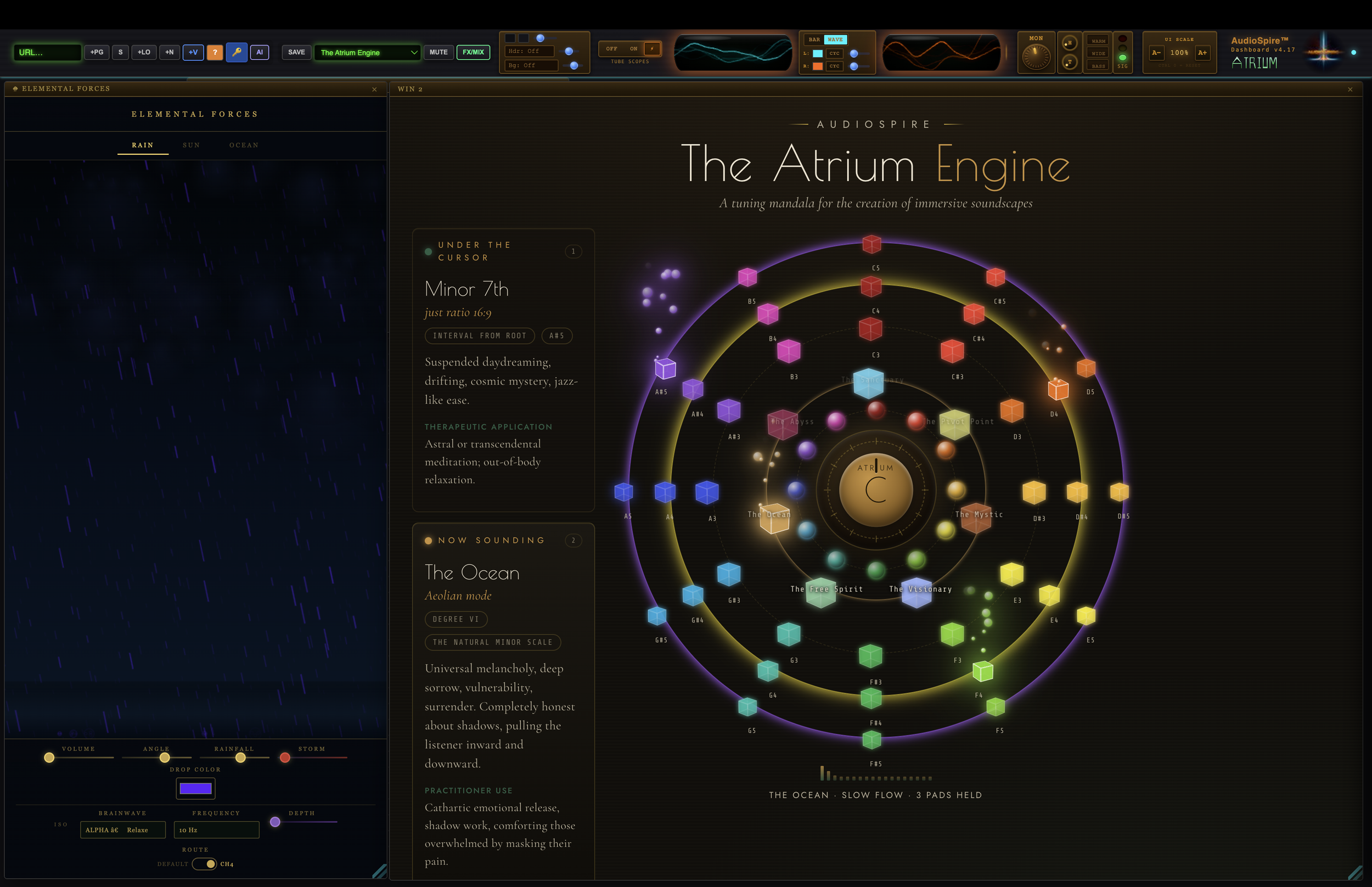
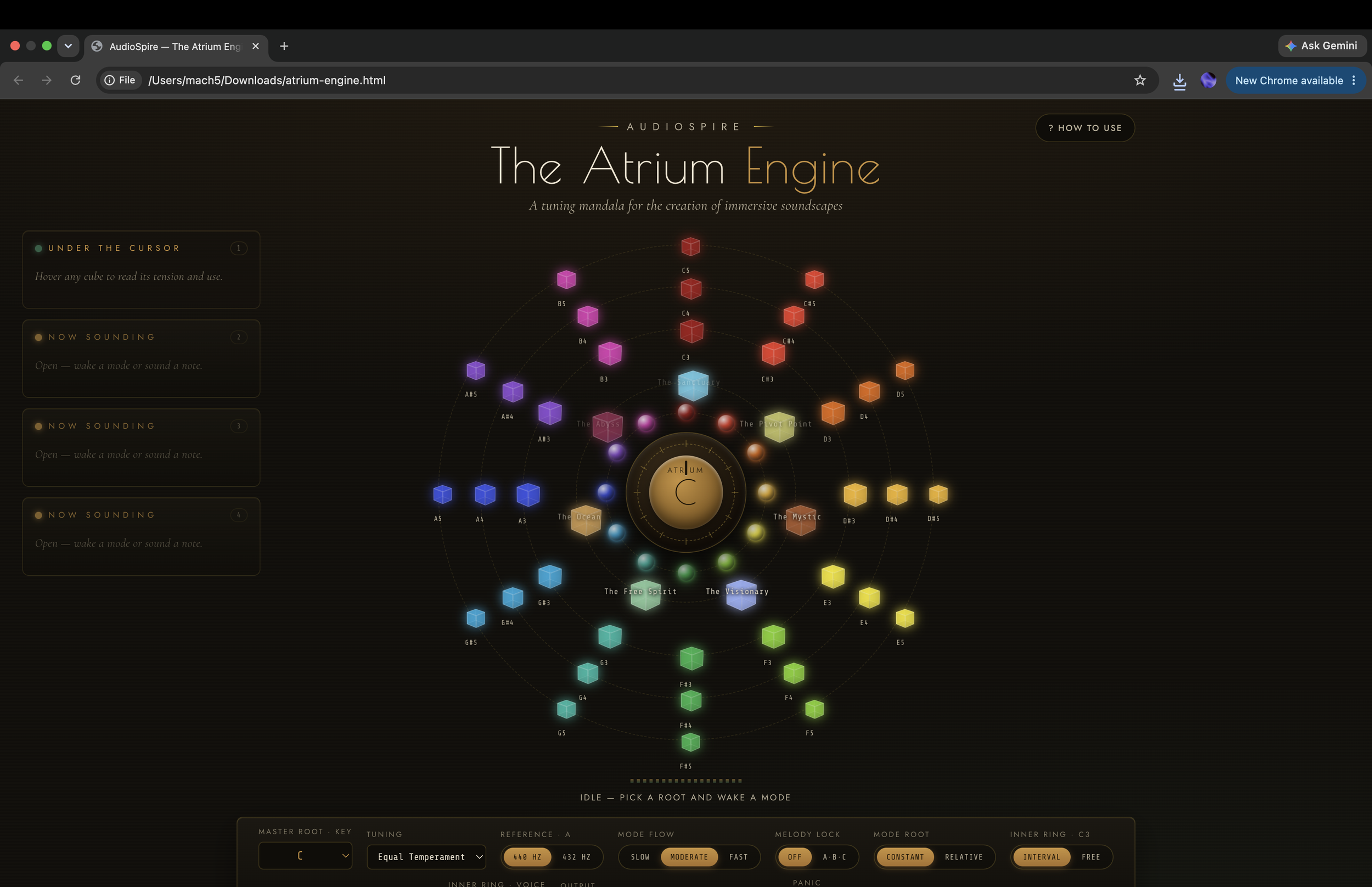
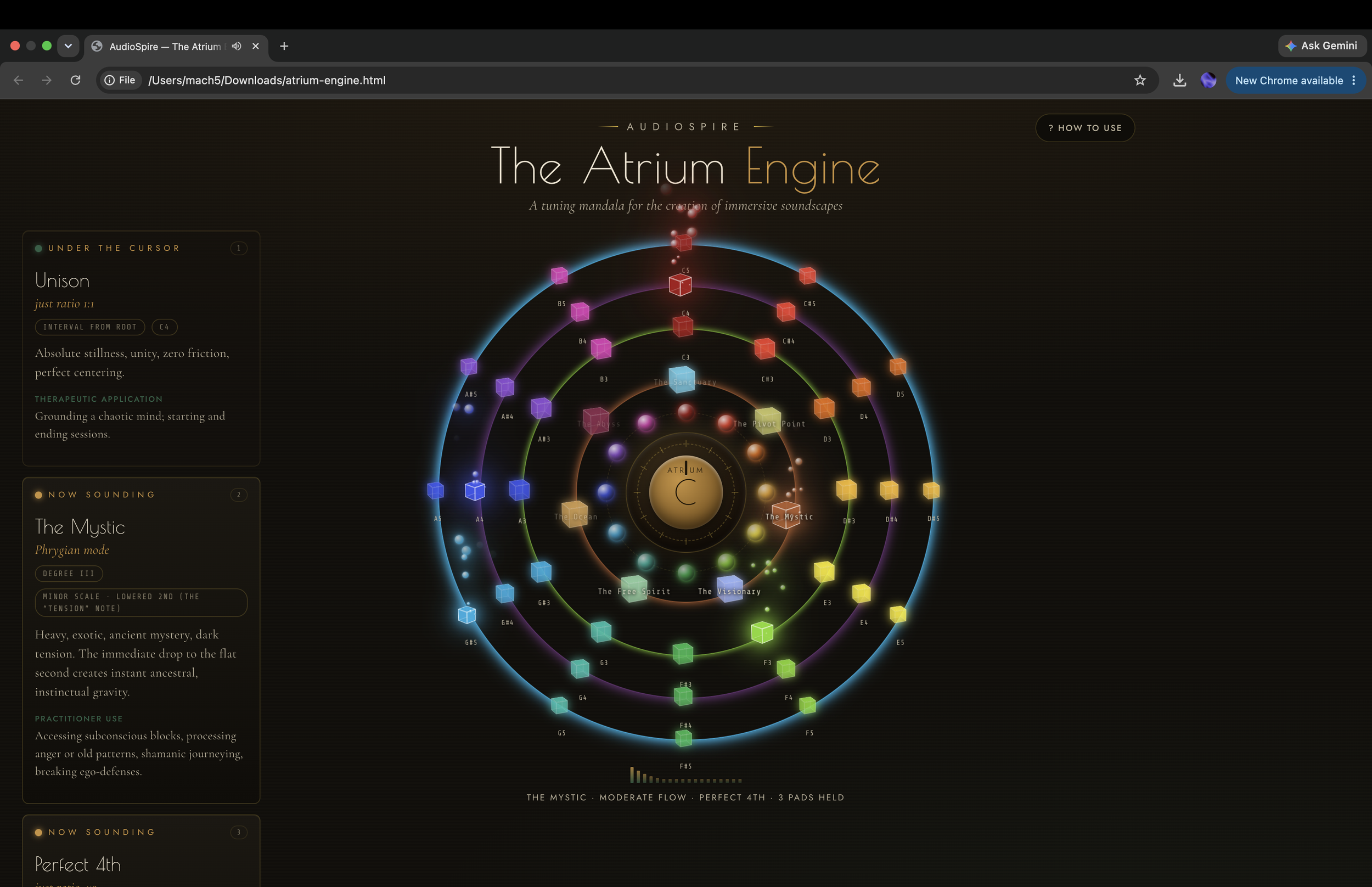
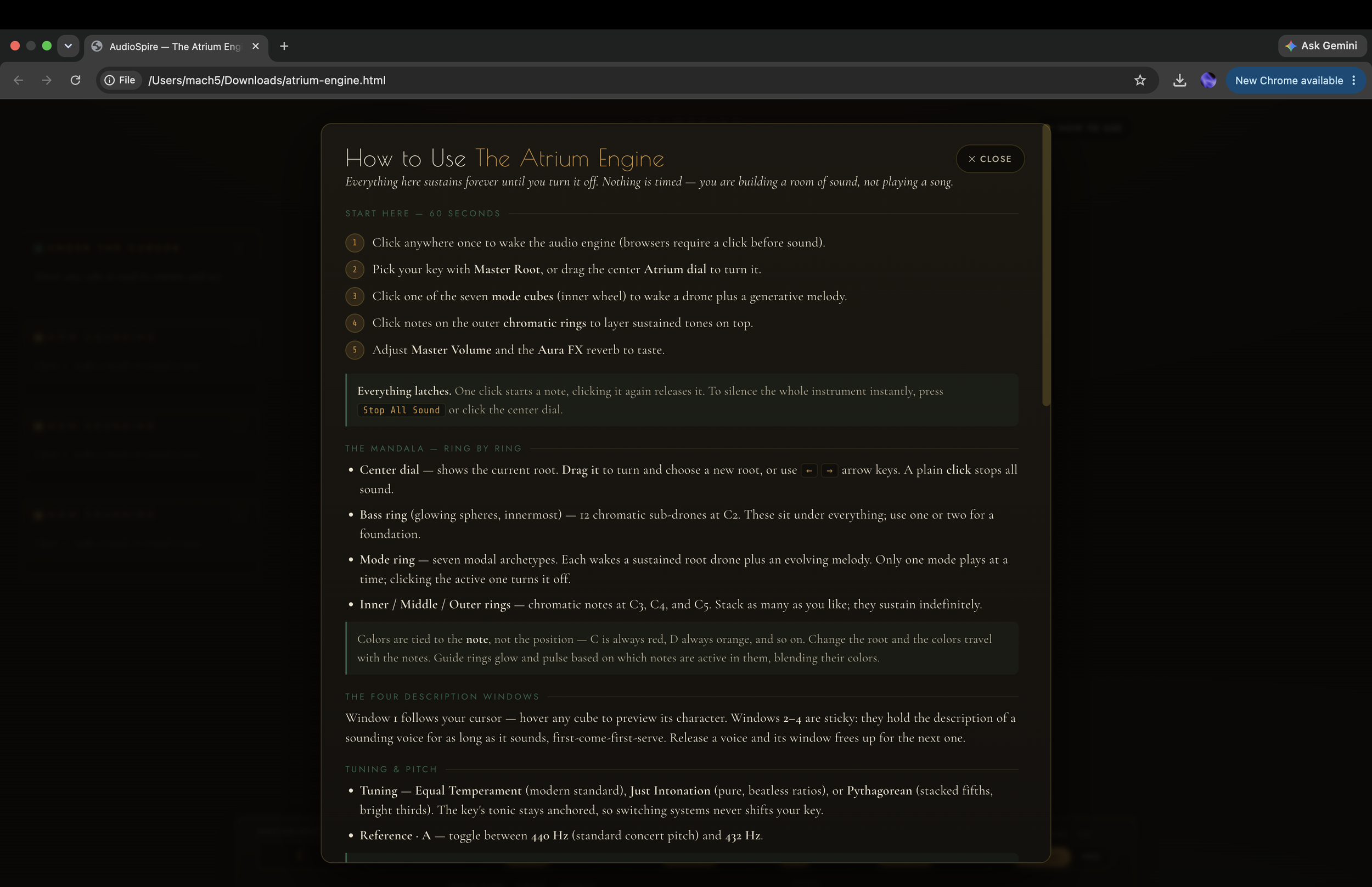
The Atrium Engine - A tuning mandala for the creation of immersive soundscapes
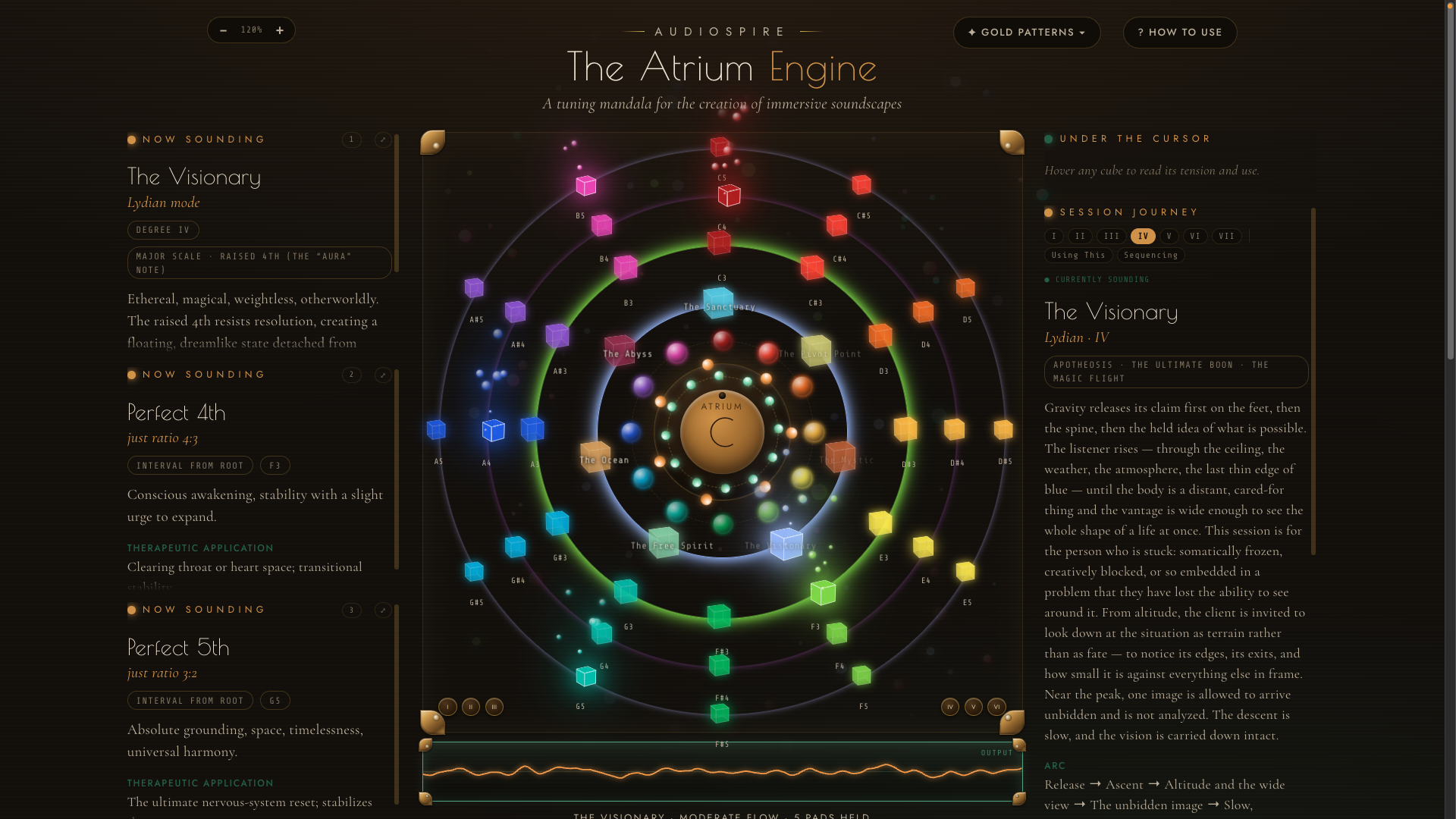
Most synthesizers ask you to think in keyboards and timelines. The Atrium Engine asks you to think in circles.
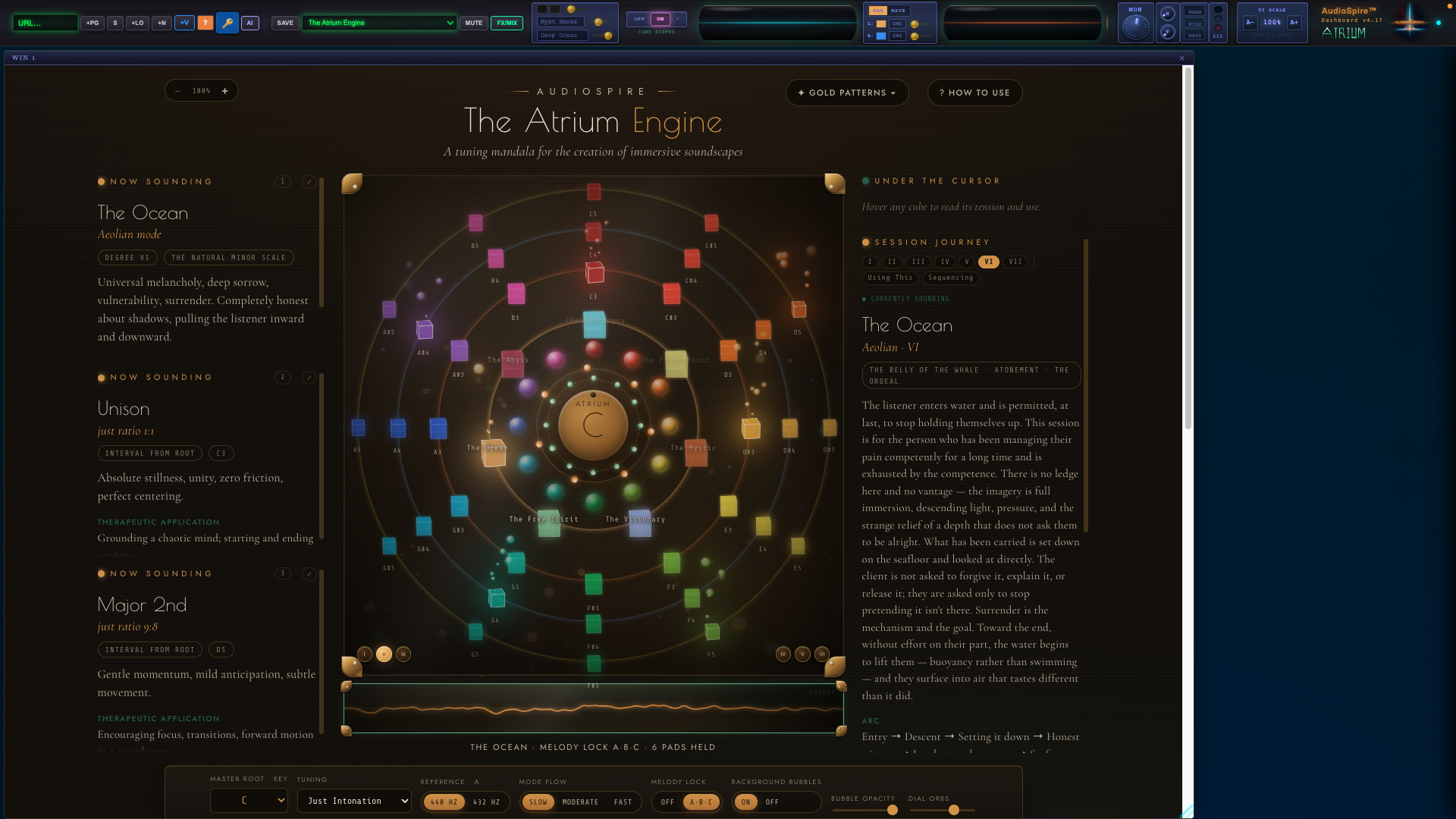
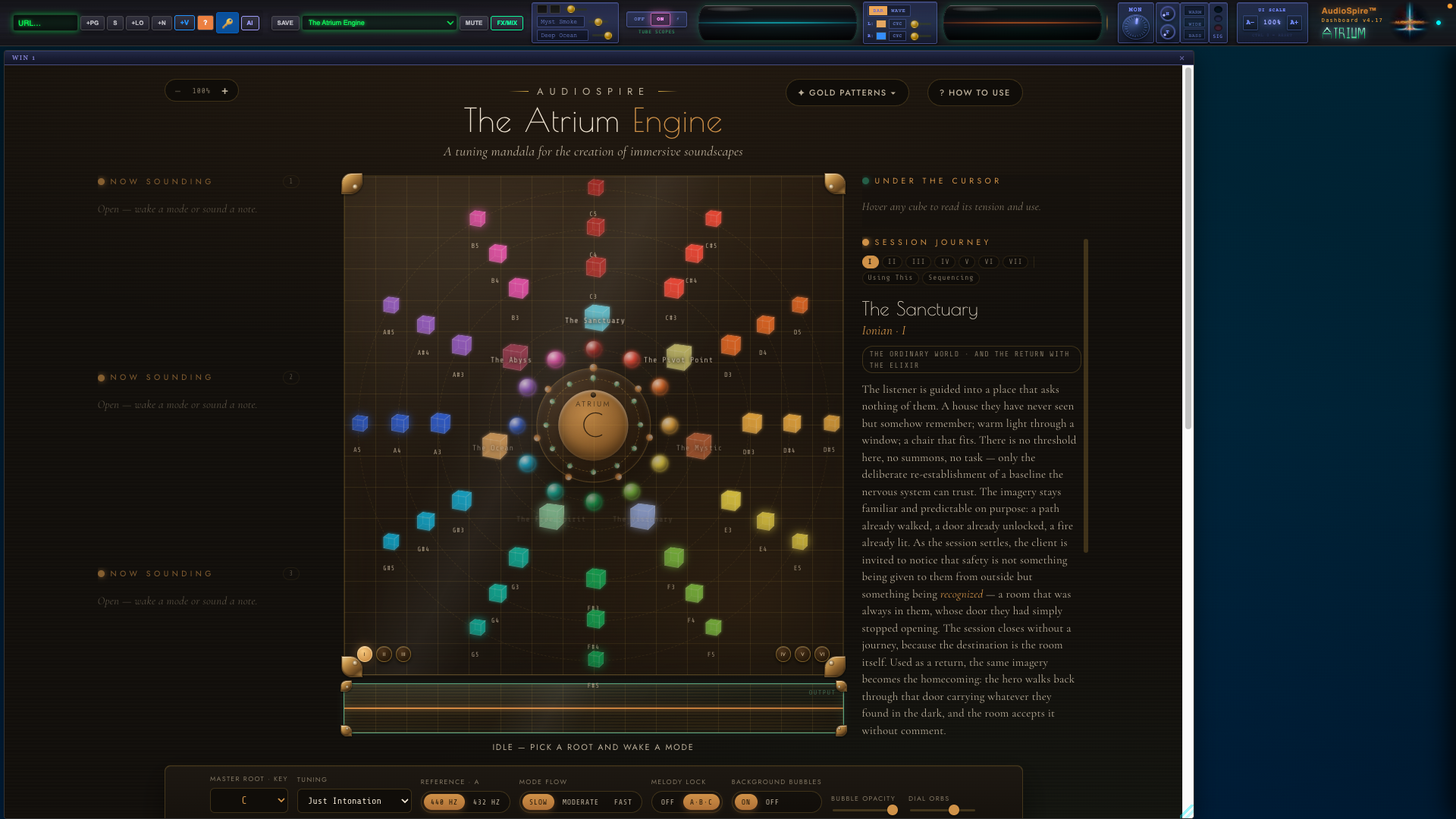
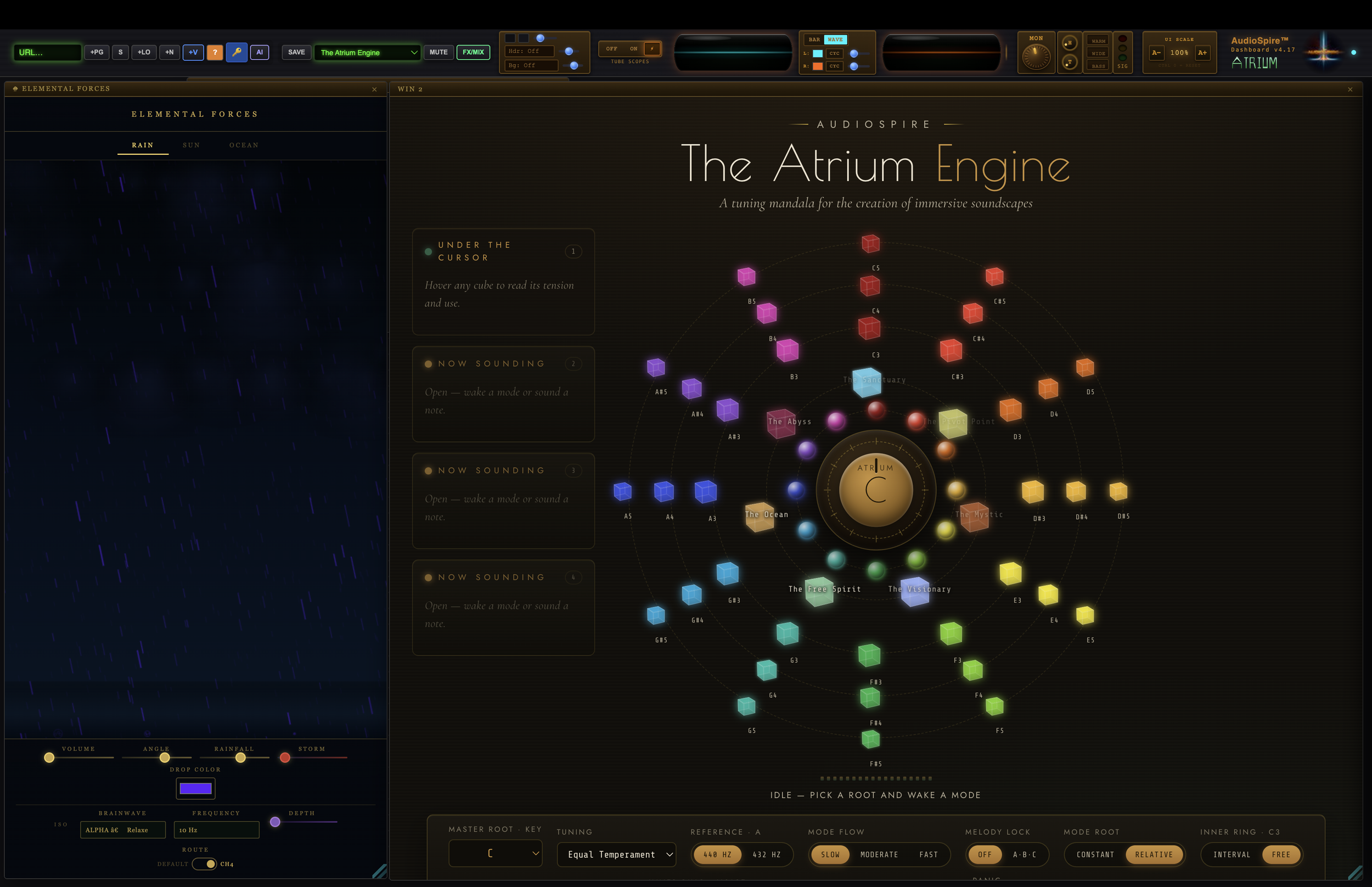
At its center is a turnable brass dial that sets your key. Around it orbit four concentric rings — a bass ring of glowing spheres, seven modal archetypes, and three octaves of chromatic tone-cubes — each note colored by its own pitch, so C is always red, D always orange, no matter which key you turn to. Wake a mode and it breathes: a sustained root drone underneath, a generative melody drifting above it, phrasing itself differently every time you listen.
Nothing here is on a timer. Every voice you touch sustains until you release it. You are not performing a piece — you are building a space, layer by layer, and then living inside it.
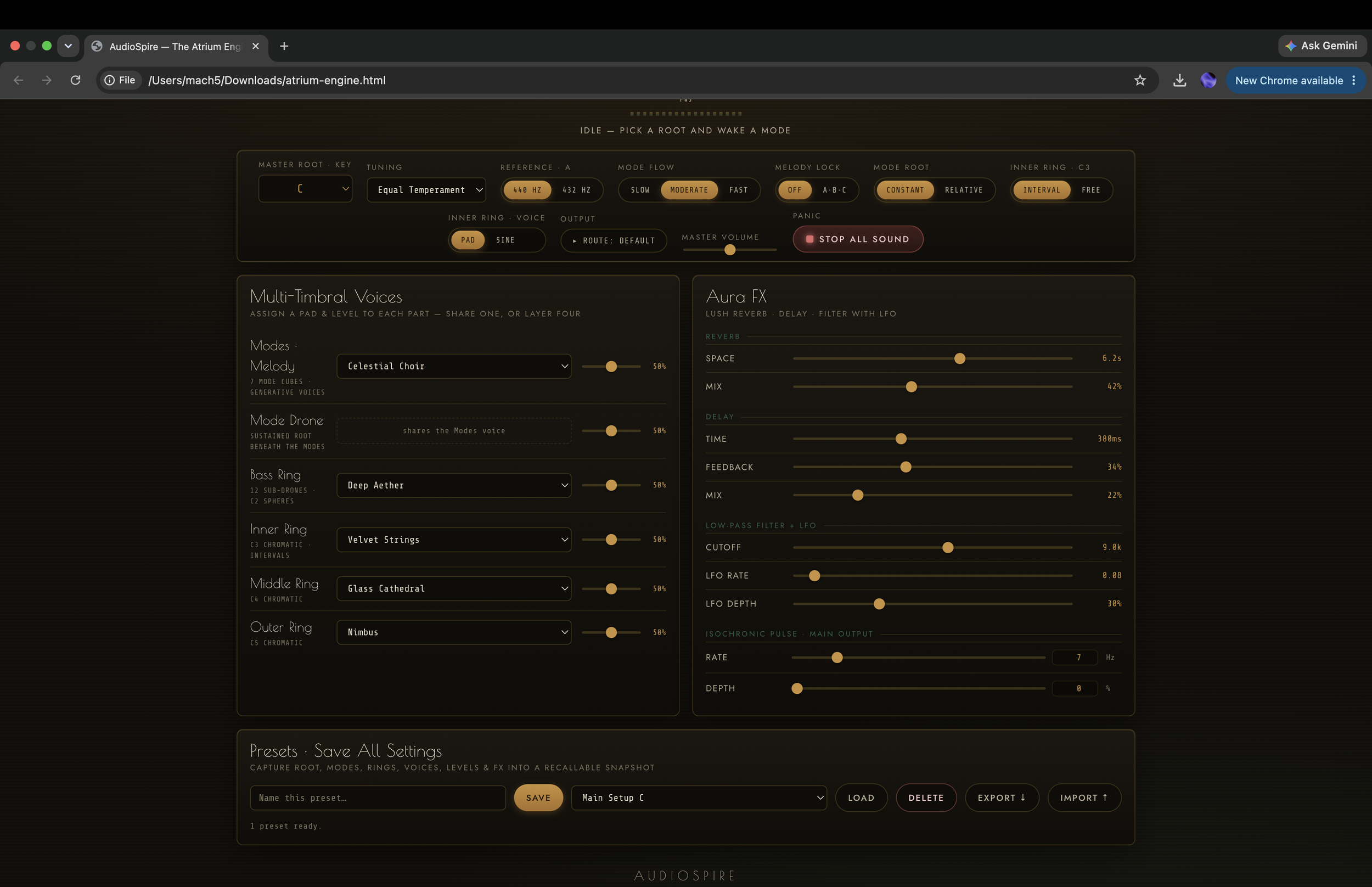
Underneath the mandala sits a genuinely deep instrument. Three historical tuning systems let you hear the difference between modern equal temperament and the pure, beatless intervals of just intonation. Reference pitch toggles between 440 Hz and 432 Hz. Melody Lock turns the generative line into structured musical phrases — call, answer, and chorus — looping endlessly without ever repeating exactly. Nine hand-built pad voices can be assigned independently to every ring, each with its own level, and the whole mix runs through cathedral-scale reverb, delay, a sweeping filter, and an isochronic pulse generator.
Then you save it. Name your sound, and every setting — key, tuning, mode, voices, levels, and effects — is captured in a single recallable snapshot you can export, carry to another machine, and load back in.
Key Features
A mandala you actually play
Four concentric rings orbit a turnable center dial. Drag the dial to change key; every note on every ring re-tunes and recolors instantly. Click any cube or sphere to sound it — click again to release it.
Color that follows the note
Each of the twelve pitch classes owns a permanent hue. Change the root and the rainbow rotates with the notes, so you learn the geography of a key by sight as much as by ear.
Seven modal archetypes
The Sanctuary, The Pivot Point, The Mystic, The Visionary, The Free Spirit, The Ocean, and The Abyss — the seven classical modes, each with its own character, drone, and generative melodic behavior.
Melody Lock — call, answer, chorus
Switch the generative line from free wandering to composed phrasing. The A phrase asks a question, ending on an unsettled degree. The B phrase answers and resolves. The C phrase arrives as a bolder chorus, doubled a third above. The loop runs A · B · A · B · C, endlessly, never twice the same.
Three tuning systems
Equal Temperament, Just Intonation, and Pythagorean — with the tonic anchored so switching systems never shifts your key. On sustained drones the difference is unmistakable: just intonation locks chords together and the beating simply vanishes.
440 Hz / 432 Hz reference
One toggle re-pitches the entire instrument.
Nine pad voices, independently assigned
Velvet Strings, Warm Analog, Glass Cathedral, Celestial Choir, Crystalline, Aurora Drift, Deep Aether, Nimbus, and a pure Sine test tone. Assign a different voice to every ring, each with its own volume — including a separate level for the mode drone, so you can sink it beneath the melody or mute the melody entirely.
Aura FX
Cathedral-scale convolution reverb, tempo-free delay with feedback, a low-pass filter with a slow LFO sweep, and an isochronic pulse generator that rhythmically modulates the entire output — with both slider and precise numeric entry for rate and depth.
Living visual feedback
Guide rings glow and undulate based on which notes are sounding, blending the colors of the active tones. Bubbles rise from every active voice. Mode titles fade and drift across the cubes.
Four description windows
One window follows your cursor for instant reference on any note or mode. Three more hold the character of your currently sounding voices for as long as they sound — so a stacked chord explains itself while you listen.
Presets that travel
Save unlimited snapshots in your browser. Export the whole library as a single JSON file and import it on any other machine or browser.
Built to be lived in
Everything sustains indefinitely. One panic button silences the instrument instantly. Full keyboard navigation, reduced-motion support, and a complete how-to guide built into the page.
Specifications
Format: Single self-contained HTML file
Platform: Any modern browser — desktop, tablet, or mobile
Installation: None. Open the file and play.
Internet required: No, after first load
Audio engine: Web Audio API, real-time synthesis
Rings: 4 (bass, modes, and three chromatic octaves)
Notes: 12-tone chromatic across C2–C5
Modes: 7 classical modal archetypes
Tuning systems: Equal Temperament, Just Intonation, Pythagorean
Reference pitch": 440 Hz / 432 Hz
Pad voices: 9, independently assignable per ring
Effects: Reverb, delay, filter + LFO, isochronic pulse
Presets: Unlimited, with JSON export/import
Accessibility: Keyboard navigable, ARIA labeled, reduced-motion aware
Who It's For
Composers and sound designers looking for evolving ambient beds, drone layers, and modal textures that can run for hours without looping.
Music students and teachers who want to see interval relationships, modal color, and the real audible difference between tuning systems.
Meditation and yoga practitioners building long-form tonal environments with specific keys, tunings, and pulse rates.
Streamers, writers, and deep workers who want a focus environment they shape themselves rather than a playlist someone else chose.
Anyone curious about sound who has never touched a synthesizer. There is no wrong note on the mandala — only different rooms to stand in.
Four Ways to Start
Deep ambient bed — one bass sphere, a mode set to Slow, reverb space high and mix around 60%.
Meditation tone — Just Intonation at 432 Hz, a single sustained bass note, isochronic pulse at 4–8 Hz.
Interval study — inner ring in Interval mode with the Sine voice, then walk the ring one note at a time and read each description as it sounds.
A piece that writes itself — Melody Lock on, Mode Flow at Moderate, a touch of delay feedback. Then walk away and let it play.
FAQ
Do I need to install anything? No. The Atrium Engine is a single HTML file that runs entirely in your browser. There is nothing to install, register, or update.
Does it work offline? Yes. Once the page has loaded, it runs without an internet connection.
Do I need to know music theory? Not at all. The mandala is built so that anything you click sounds good together within the chosen key. The built-in guide and the live description windows teach the theory as you play, if you want it.
Can I record what I make? The engine includes an output routing option for capturing audio. For most users, any screen or system audio recorder will capture the output directly.
Where are my presets stored? In your browser's local storage, tied to the page. Use Export to download your entire preset library as a single file you can back up or move to another device, then Import to load it there.
Will it work on my phone? Yes. The layout adapts to phones and tablets, and the mandala is fully touch-responsive. Headphones are strongly recommended — small speakers lose the low drones entirely.
What is the isochronic pulse for? It rhythmically pulses the entire output at a rate you choose, a technique commonly used in ambient and meditative sound work. Set the depth above zero to enable it and dial in any rate from 0.5 to 40 Hz.